Non-Explosive
Definition (Non-explosive)
A continuous-time process is non-explosive if and explosive otherwise.
Intuition
Given the jump times, , and jump chain, , we usually want to recover . Pick , if such that then we have that But, this only works if is non-explosive or . So we’ll want to primarily deal with non-explosive processes going forward.
Intuition 1.5
For non-explosive We’re saying that as we count up the number of jumps (i.e. ) then the jump times will also go up (). For explosive we’re saying that there’s some point where even though we increase the number of jumps to the time these occur are finite implying that our jump chain has exploded (which shown to be below).
Intuition 2
What does “non-explosive” mean? Well essentially by inspecting the following figure: 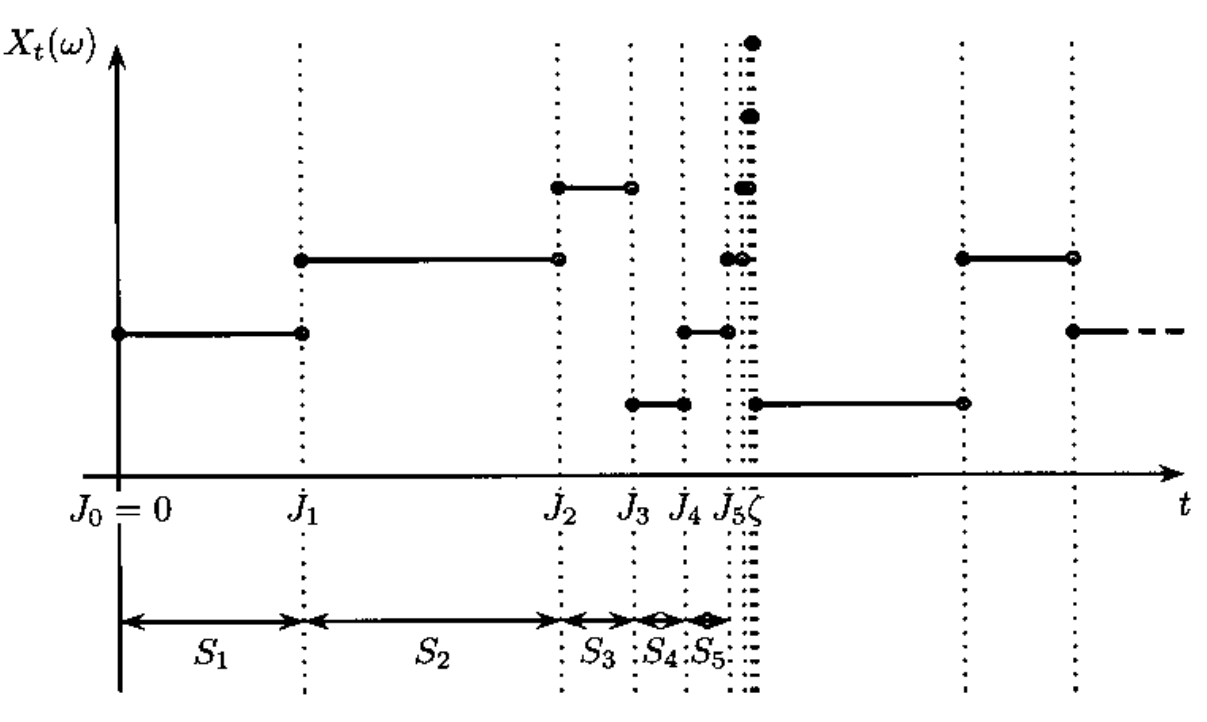 We see here explodes or diverges at this shows that we make infinitely many jumps inside a finite interval. A non-explosive process does the opposite, it only jumps finitely many times inside any finite interval.