Genetic Algorithms
Introduction
Evolutionary algorithms are based on Darwinian evolution. Some basic concepts are:
- Population
- Fitness
- Selection
- Mutation Individuals that adapt well have a high probability of generating offspring.
Definition (Evolution)
Evolution is a process that acts on populations of individuals. Information is stored in the form of chromosomes with each chromosome containing many genes. In an EA
- A population of candidate solutions is formed (randomly)
- Each individual is evaluated (decode their information/chromosomes then evaluated) and assigned a fitness score based on performance.
- New individuals are formed through the process of selection, crossover, and mutation
- Repeat until a new population is formed.
- Once new population is formed we check if we’ve met our termination condition, if not start the whole process again.
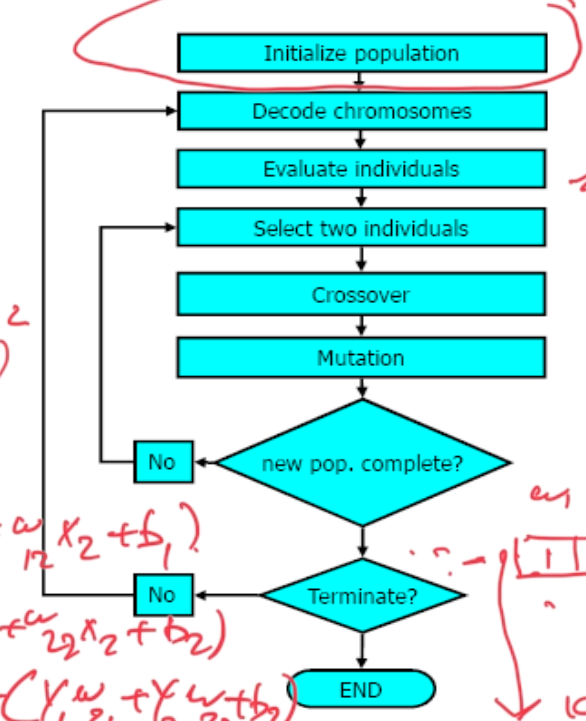
Definition (Chromosome)
In a genetic algorithm, a chromosome encodes the information of an individual in a population. These are typically represented using a string of digits usually binary.
Definition (Phenotype)
In Genetic Algorithms, we use to represent information of an individual. This is mapped into the phenotype space to represent the encoded information of the genotype in its functional or physical form. Can think of phenotype as the decoded representation of genotype of chromosome. We evaluate fitness based on phenotype representation.
Definition (Binary Encoding)
In this encoding scheme we define the alphabet or alleles to be or .
Definition (Messy encoding)
In messy encoding we generate a less position-dependent representation by associating each gene with a number (i.e. its position). For a example a Chromosome or Genotype of length with indicating the position in the chromosome and being the corresponding allele.
Definition (Real number encoding)
In this application a gene holds a floating point number in the range from which the corresponding variable is obtained as formed with
Definition (Selection)
Selection is the process that takes in the individuals of a population and based on their fitness selects the individuals to produce offspring.
Definition (Roulette-wheel selection)
Roulette-wheel defines a cumulative relative fitness value, , for each individual as where each is the fitness of individual . Next a random number is drawn and the selected individual is the taken as the one with the smallest that satisfies .
Definition (Tournament selection)
This method consists of picking two individuals randomly (i.e. with equal probability for all individuals) from the population, and then selecting the one with higher fitness with probability , which we define as the tournament selection parameter. We draw a random number and if we select the better of the two, otherwise we select the worse of the two.
Definition (Fitness ranking)
Here we give the best individual fitness (the population size) and continue in decreasing order to the worse individual with fitness . Let denote the ranking of individual , defined such that the best individual has ranking , the fitness values are obtained like so:
Definition (Crossover)
This is where two of selected offspring “breed”. There are two types:
In single-point crossover a single crossover point is selected and the two children are formed from the spliced chromosomes of their parents which are both separated and attached at that point In point crossover, crossover points are selected randomly and the the chromosome parts are chosen from either parent with equal probability.
In averaging crossover, a gene in the offspring taking values and in two parents takes the values
Definition (Mutation)
Mutations are carried out on a gene-by-gene basis. Thus, in principle, the number of mutated genes can range from to . We define the mutation probability as which is typically set as where is a constant of order and is the length.
Binary Encoding
Here we just flip bits.
Real Encoding
Here we select a random number in the allowed range (i.e. ). The mutated value (allele) of a gene is centred on the previous value, and the creep rate determines how far the mutation may take the new value. The value of the gene changes according to where is a suitable distribution, for instance a uniform distribution. In this case we get where is the uniform random number in and is the creep rate (i.e. the width of the distribution).
Definition (Boltzmann Selection)
️️️️️️️In this method we define the notion of temperature as a tuneable parameter for determining selection pressure. This notion of selection pressure is the extent to which high-fitness individuals are preferred over low-fitness ones.
We can implement it similarly to the two previous ones:
Roulette-Wheel Selection
The probability of selecting individual is Individuals are selected with approximately equal probabilities if is large and vice versa for small (high-fitness preferred).
Tournament Selection
Pick two individuals and randomly from the population. During selection a random number is generated and the selected individual is determined according to with and as the fitness values of the two individuals. For large the probability of either getting chosen is equal, if is small, the better of the two is selected more often.